A mobile audiologist who comes to your home.
Your home is the exam room, from your first hearing test through years of follow-up.
This is not a van clinic or a quick check-up. It is concierge-level audiology delivered in the place you already feel most comfortable, with professional-grade equipment and two decades of clinical judgment guiding every step.
Your mobile hearing test, step by step.
A first visit runs 60 to 90 minutes. I bring everything, and all you need is a table, two chairs, and a nearby outlet.
We talk first
What has changed, what frustrates you, and what matters most to fix. Family members are welcome, and they often add a lot.
I look and I test
An ear exam, then a full diagnostic hearing test, including how well you understand speech in background noise.
Plain-language results
I walk you through what I found, with no rushing and no jargon. If something needs a physician first, I say so and refer you.
A plan built on your goals
If treatment makes sense, we build your Care Plan together. If you do not need hearing aids yet, I will tell you that too.
Fitting and follow-up at home
Hearing aids are fitted and verified with Real-Ear Measurement in your ears, followed by listening training and ongoing care with me.
Curious about the details? Read what actually happens during an in-home hearing test.
The Sound and Sense Method™
A program, not a purchase.
Your ears take in sound. Your brain turns it into sense. The Sound and Sense Method™ takes care of both, in four stages, all delivered in your home.
Evaluate
A fit check call, then a full evaluation in your own listening environment. Schedule by phone or online, and I arrive with professional-grade diagnostic equipment. I build your treatment plan around your goals and set the baseline every future decision is measured against.
Treat
When treatment is warranted, I fit and verify your hearing technology so it matches your prescription in your ears, not the manufacturer's default. All major manufacturers, independent recommendations.
Train
Listening training and communication coaching for you and your family, with follow-ups through your first year. The brain needs practice with its restored input, not just a device.
Support
Ongoing care for as long as you are a patient. Scheduled rechecks, adjustments as your hearing changes, and the same audiologist at every single visit.
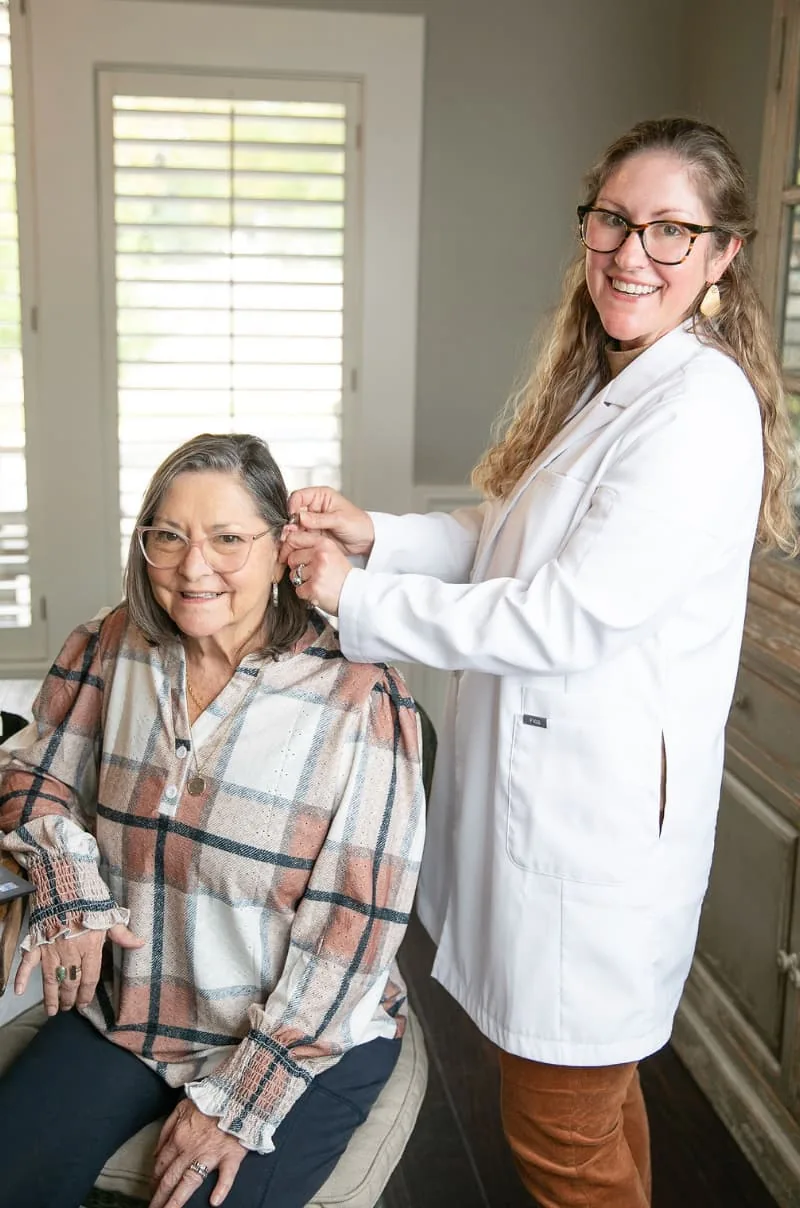
Care that meets you where you are.
Bringing care into your home removes the common barriers that keep people from getting help. No driving, no parking, no waiting rooms. Just one-on-one attention in the comfort and privacy of your own surroundings.
I can also test your hearing in the very spaces where you live and communicate. That makes my recommendations more practical, because they are grounded in your actual environment, not a soundbooth.
Many patients feel more at ease asking questions when they are at home, and family members are welcome to join, adding valuable context to the conversation.
There is never a charge for the drive, and every price is shared before you decide. Here is how private-pay hearing care works.
A clearer way to compare.
Traditional Clinic
- Requires travel, parking, and often waiting
- Shorter appointment times
- Testing in a soundbooth, not your environment
- Bundled pricing with hidden costs
- Limited flexibility for family involvement
Concierge Mobile Care
- Care delivered to your home, office, or community
- Unhurried, one-on-one appointments
- Real-world environment testing
- Transparent, itemized pricing
- Family welcomed into every conversation
What patients say about home visits.
Read the transcript
Dr. Sommers: What are your thoughts about having your hearing health care provided in your own home versus in a clinical setting? Patient: I've done both now. I have not had it done in my home before, and I have been to a very nice clinic. Good people. Great equipment, I suppose, as far as I know, and all of that. But there is a difference when you have it in your own environment, as opposed to being in a small office with an audiologist or being in a booth or something like that. For me there simply is no comparison.
Read the transcript
Dr. Sommers: What about the difference in seeing your audiologist in a clinical setting versus them coming to your home? How has that part of your experience been? Patient: I like it. The fact that I was going to the clinic, that was fine. You know, that's what you do when you see the doctor. You go to the doctor's office. Well, then I found out she could come to me. Wasn't sure exactly how that was going to work, but it has worked out just fine and I like it. It's very convenient for me and it works out fine.
Real patients, in their own homes. Transcripts are lightly edited for readability. Individual experiences vary.
Clinic-grade equipment. Compact, calibrated, portable.
The single most common question I hear is whether at-home testing can really match what you would get inside a clinic. The short answer is yes, and here is exactly what I use to do it.
Portable Diagnostic Audiometer
Same range of pure tone, bone conduction, and speech testing as a stationary clinic unit. Calibrated annually to the same standard. I test the full diagnostic frequency range, including extended high frequencies for patients who need them.
Insert Earphones & Bone Oscillator
Clinical-grade insert earphones (not consumer headphones) for accurate threshold testing, plus a bone oscillator for assessing conductive versus sensorineural loss. The same hardware used in any audiology clinic.
Real-Ear Measurement System
A probe microphone system that measures sound at the eardrum during hearing aid fittings. This is the gold standard for verifying that hearing aids deliver sound exactly as prescribed inside your unique ear canal, and I perform it in your real listening environment, not a booth. How Real-Ear Measurement works.
Otoscope & Video Otoscope
Standard otoscope for examining the ear canal and tympanic membrane. Video otoscope available when patients (or family members) want to actually see what I am seeing.
Speech-in-Noise Testing
QuickSIN or equivalent protocol to assess how you function in real-world listening environments, not just a quiet booth. This is the single most relevant test for predicting how you will do with hearing aids.
Cerumen Management Tools
Clinical curettes and a low-pressure irrigation system for safe, in-home earwax removal when needed. Often the simplest fix when hearing has gradually gotten worse.
All equipment is calibrated annually by an independent service per ANSI standards, just like the equipment in any accredited clinic.
About how this actually works.
The practical questions patients ask before their first home visit.
Yes, when it is done with the right equipment by a Doctor of Audiology. The equipment I use is the same diagnostic-grade hardware found in clinics, calibrated annually to ANSI standards. The testing protocols are identical. The difference is environmental: you are in your own listening world, which actually makes some tests (like speech-in-noise) more clinically meaningful, not less.
The clinical-grade insert earphones I use provide significant ambient noise attenuation, enough to perform reliable threshold testing in any reasonably quiet room. If I encounter a specific issue (a barking dog next door, construction outside), I adapt: move to a different room, schedule for a quieter time, or use a sound-isolating headphone setup. I have done this in hundreds of homes.
A first-time evaluation runs 60 to 90 minutes. That includes the actual diagnostic testing (about 30 minutes), the otoscopic exam, and the conversation about what I found and what the options are. Follow-up visits for hearing aid fittings or adjustments are usually 45 to 60 minutes.
Almost nothing. Make sure you have a flat surface (kitchen table, dining table, desk) and two chairs near a power outlet. If you have any previous hearing test reports, audiology records, or a list of current medications, having those nearby helps. If a spouse or adult child wants to sit in, ask them to be present.
That is exactly the population this practice was built for. I test patients in wheelchairs, in recliners, in bed if necessary. I come to assisted living facilities, memory care units, rehabilitation centers, and private residences with full accessibility setups. The audiology comes to you, in whatever form that takes.
Yes. In fact, in-home audiology is often the most reliable way to test patients with memory loss or cognitive impairment, because the unfamiliar clinic environment can cause confusion that masks their actual hearing ability. I adapt my testing protocol, work with caregivers who know the patient, and pace the visit to what the patient can handle that day.
If I identify anything that warrants medical attention (sudden hearing loss, asymmetric hearing thresholds, signs of middle-ear pathology, or anything that suggests an underlying medical cause), I refer you back to ENT or your primary care physician with a formal written report the same day. I do not treat outside my scope.
If you live in Spring, Klein, Tomball, Cypress, The Woodlands, Shenandoah, Conroe, Kingwood, or Humble, I come to you. Your home, your office, or your senior living community all work. If you do not see your town, call (713) 570-6370 and ask.
The same diagnostic testing you would expect in a clinic: an ear exam, a full hearing test across pitches, word understanding, and speech-in-noise testing. Then I go over the results with you in plain language at your table.
Not always. Mobile hearing providers can be audiologists or hearing instrument specialists, and the training is different. I am a Doctor of Audiology. Here is how the two differ and what to ask.
Proudly serving North Houston.
If you live in any of these communities, concierge care comes to you.