Why Hearing Checks Deserve a Place in Your Community's Care Plan
A few months ago, I ran a complimentary hearing clinic at a senior living community. One resident who stopped in had significant vision issues already, and mostly kept to her apartment. But she mentioned something that stuck with me: she really looked forward to her time with friends in the dining room, and lately, she had been struggling to keep up with the conversation there.
I tested her hearing, built a treatment plan around her specific needs, and started treatment. Months later, she is more engaged in her community, and by her own account, happier than she has been in years.
She is exactly the kind of resident who might never bring up a hearing concern on her own, especially with vision already a bigger, more visible issue. A simple screening event was what actually surfaced it.
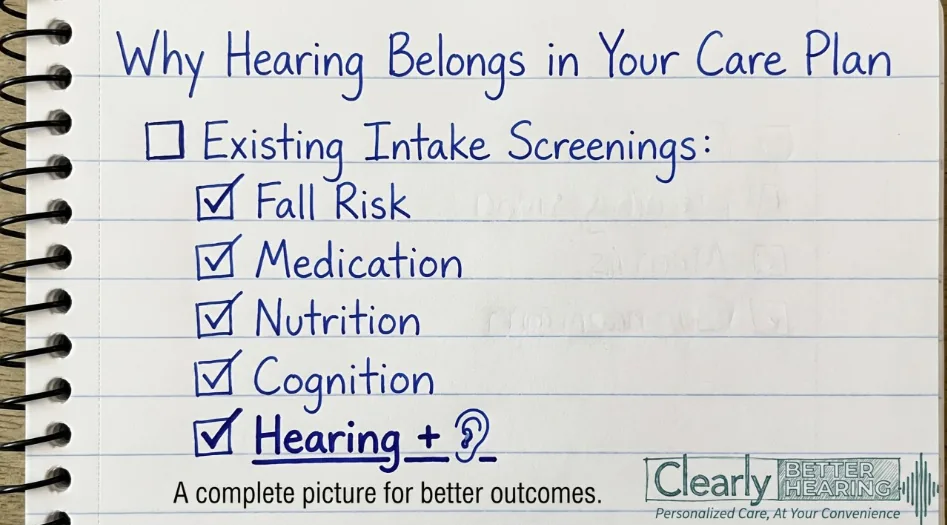
If you run a senior living community or a home health agency, you already screen for a long list of things: fall risk, medication interactions, nutrition, mobility, cognitive status. Hearing is rarely one of them, and stories like hers are part of why that is worth reconsidering.
Untreated hearing loss touches nearly every outcome your team already tracks. It is tied to higher fall risk, since the inner ear handles both hearing and balance, and hearing loss changes how much attention the brain has left for staying steady. It is linked to faster cognitive decline in some patients, since straining to hear pulls resources away from memory and focus. And it quietly reduces engagement. Residents who cannot follow dinner table conversation or activity announcements tend to withdraw, not because they have lost interest, but because keeping up has become exhausting.
For home health agencies, the stakes are just as real. A patient who cannot clearly hear instructions, medication changes, therapy exercises, safety reminders, is at higher risk of a preventable setback. And family members often cannot tell whether a loved one's confusion or disengagement is cognitive or simply a hearing gap nobody has tested for.
Here is the part that is easy to miss: most residents and patients with hearing loss do not know they have it, or do not know it is treatable. Hearing loss usually develops so gradually that the brain adjusts and stops registering what is missing. That means waiting for someone to complain about their hearing is not a reliable way to screen for it. It has to be asked about directly, and ideally tested.
Adding a simple hearing check to intake or annual assessments does not require much from your team. A basic set of questions, TV volume, phone calls, group settings, table conversation, can flag who is worth referring for a full evaluation. For residents or patients who are mobility-limited or homebound, an in-home hearing evaluation removes the biggest logistical barrier, since testing happens on-site rather than requiring transportation to a clinic.
The upside reaches further than the individual resident or patient. Families notice when a loved one becomes more present at dinner, more responsive to staff, less isolated. That shows up in satisfaction scores, in family trust, and in the day-to-day ease of your team's job.
If you would like to talk through adding a simple hearing screening question to your intake process, or want to set up a referral relationship for residents or patients who need a full evaluation, I am happy to help make that easy.
Working with older adults, residents, or homebound patients? I would be glad to be a resource.
How Referrals Work